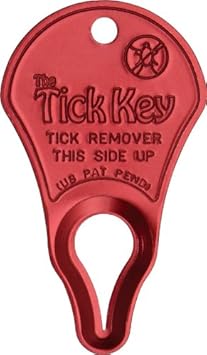
[see illustrations at link, using needle nose - not flat - tweezers]
DO NOT JERK OR TWIST THE TICK.
This might tear the head and mouth parts from the tick's body and can push tick fluids directly into your skin or blood stream.
DO NOT USE YOUR FINGERS TO REMOVE THE TICK.
Squeezing the tick could cause it to release the contents of its body into the wound.
Remember, you can contract Rocky Mountain Spotted Fever simply by handling ticks and having their excretions absorbed through your skin.
DO NOT ATTEMPT TO REMOVE THE TICK WITH CHEMICALS (such as nail polish remover, liquid soap, kerosene, oils, etc)
or BY HEATING IT WITH A MATCH.
This can kill the tick before it disengages its mouthparts.
It can also cause the tick to regurgitate its contents into the wound, increasing the likelihood of transmitting a number of diseases.
WASH THE TICK ATTACHMENT SITE.
Use warm soapy water and/or rubbing alcohol. You can apply an antibiotic ointment to help protect the bite site from additional contamination and secondary infections.
SAVE THE TICK.
If you want to send it for testing (not generally recommended) place it in a small sealed ziplock bag with a very slightly damp cotton ball (not wet). Keep it in the refrigerator until you are ready to ship it.
Remember- testing a tick does not guarantee the organisms in it will be detected, or that the infectious organisms were passed to you.
NEVER wait for the tick test results to come back before being treated. Remember, the earlier the treatment the better!
- Much more information information at the the link above. -
Posted by Keebler (Member # 12673) on :
I have the Pro-Tick Remedy which is shown in Keebler's study.
I have removed adult and nymph deer ticks with it.
It is easiest to remove the tick if you hold a magnifying glass over the tick. This way, you place the tool in such a way that when you slide it toward the tick, the tick is separated from the skin by the tool.
Then, you just pull up lightly and wait for the tick to withdraw its mouthparts. Voila!
The Pro Tick comes with a little magnifying glass, but if I am at home doing it, I use a separate glass one that is better than the plastic one that comes with the tool.
You have to be calm to slide the tool just right for the tiny nymphs. The adults are a lot easier, but still you may have to try sliding the tool under the tick 3-5 times before you get good at keeping the tick above the tool.
This tick remover is so cheap that I bought a few and keep one in my purse, one at home, etc.
It comes with nice instructions and tick identification photos.
Posted by mlefev (Member # 20586) on :
I know they say vasoline doesn't work, but I've tried it before and the nasty things seemed to start wriggling back in a matter of minutes. Of course I only tried this on my dog. I couldn't very well ask him how he felt afterward...
Posted by Keebler (Member # 12673) on :
- mlefev,
It's not so much that the tick may not detach but it gets it upset and then it spews the contents of its belly into the bite site, raising the chances for a more serious array of infections.
-------------------------
DO NOT ATTEMPT TO REMOVE THE TICK WITH CHEMICALS (such as nail polish remover, liquid soap, kerosene, oils, etc)
or BY HEATING IT WITH A MATCH.
This can kill the tick before it disengages its mouthparts.
It can also cause the tick to regurgitate its contents into the wound, increasing the likelihood of transmitting a number of diseases. . . . -
Posted by nefferdun (Member # 20157) on :
We don't have deer ticks but hemostates work well for wood ticks. They will not slip like tweezers.